About a month ago I decided that it would be cool if I could solve the bug GHC’s runtime never terminates unused worker threads. Well, I just got around to looking at it today, and after wandering aimlessly around the twisty maze that is the GHC RTS for an hour or so, I finally found a light at the end of a tunnel, in the form of a heart-warmingly simple patch. I’ve sent mail off to Simon Marlow to make sure the light isn’t actually a train, but it occurred to me that it would be interesting to look at my command history and blog about the process by which I came to the conclusion that line 464 of Capability.c was the correct place to add my change, since this sort of mental journey is not the one that is really ever recorded anywhere in any shape or form.
Read more...
This is a post to get some Google juice for a problem that basically prevented Scripts from being able to cut over from Fedora 11 to Fedora 13. The cluster of new machines kept falling over from load, and we kept scratching our heads, wondering, “Why?”
Turns out, the following commit broke mod_fcgid in a pretty terrifying way: essentially, mod_fcgid is unable to manage the pools of running FastCGI processes, so it keeps spawning new ones until the system runs out of memory. This is especially obvious in systems with large amounts of generated virtual hosts, i.e. people using mod_vhost_ldap. It got fixed in mod_fcgid 2.3.6, which was released last weekend.
Read more...
This is a bit of a provocative post, and its impressions (I dare not promote them to the level of conclusions) should be taken with the amount of salt found in a McDonald’s Happy Meal. Essentially, I was doing some reading about medieval medicine and was struck by some of the similarities between it and computer engineering, which I attempt to describe below.
Division between computer scientists and software engineers. The division between those who studied medicine, the physics (a name derived from physica or natural science) and those who practiced medicine, the empirics, was extremely pronounced. There was a mutual distrust—Petrarch wrote, “I have never believed in doctors nor ever will” (Porter 169)—that stemmed in part from the social division between the physics and empirics. Physics would have obtained a doctorate from a university, having studied one of the highest three faculties possible (the others being theology and law), and tended to be among the upper strata of society. In fact, the actual art of medicine was not considered “worthy of study,” though the study of natural science was. (Cook 407).
Read more...
Someone told me it’s all happening at the zoo…
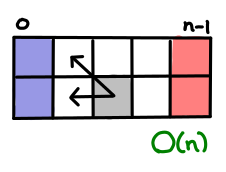
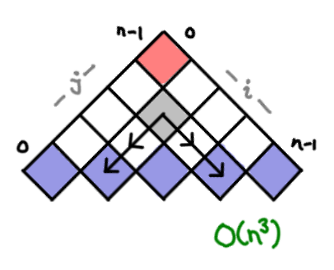
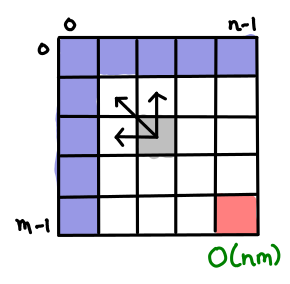
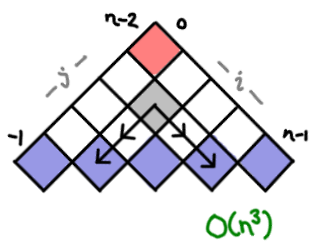
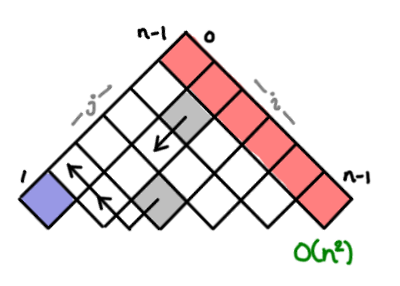
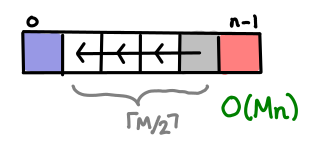
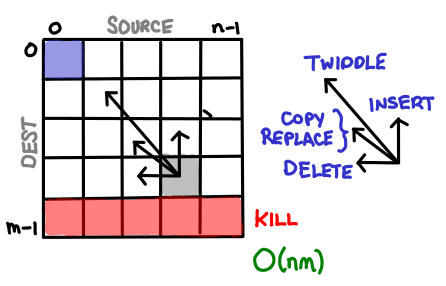
I’ve always thought dynamic programming was a pretty crummy name for the practice of storing sub-calculations to be used later. Why not call it table-filling algorithms, because indeed, thinking of a dynamic programming algorithm as one that fills in a table is a quite good way of thinking about it.
In fact, you can almost completely characterize a dynamic programming algorithm by the shape of its table and how the data flows from one cell to another. And if you know what this looks like, you can often just read off the complexity without knowing anything about the problem.
Read more...
Should software engineers be required to implement the abstractions use before using them? (Much like how before you’re allowed to use a theorem in a math textbook, you have to prove it first.) A bit like reinventing the wheel for pedagogical purposes.
(I’ve been sick since Saturday, so it’s a Dead Edward Day. Hopefully I’ll clean up the DP Zoo post and present it with more annotations for this Friday.)
Read more...
My parents like foisting various self-help books on me, and while I sometimes groan to myself about it, I do read (or at least skim) them and extract useful bits of information out of them. This particular title quote is from Robert Kiyosaki’s “rich dad” in Rich Dad, Poor Dad.
“Intelligence is the ability to make finer distinctions” really spoke to me. I’ve since found it to be an extremely effective litmus test to determine if I’ve really understood something. A recent example comes from my concurrent systems class, where there are many extremely similar methods of mutual exclusion: mutexes, semaphores, critical regions, monitors, synchronized region, active objects, etc. True knowledge entails an understanding of the conceptual details differentiating these gadgets. What are the semantics of a signal on a condition variable with no waiting threads? Monitors and synchronized regions will silently ignore the signal, thus requiring an atomic release-and-wait, whereas a semaphore will pass it on to the next wait. Subtle.
Read more...
…because I don’t live in a room numbered 245s anymore. Yep. :-)

This is a cow. They munch grass next to the River Cam.
Pop quiz. What do matrix-chain multiplication, longest common subsequence, construction of optimal binary search trees, bitonic euclidean traveling-salesman, edit distance and the Viterbi algorithm have in common?
I’ve started formally learning OCaml (I’ve been reading ML since Okasaki, but I’ve never written any of it), and here are some notes about differences from Haskell from Jason Hickey’s Introduction to Objective Caml. The two most notable differences are that OCaml is impure and strict.
Features. Here are some features OCaml has that Haskell does not:
- OCaml has named parameters (
~x:i binds to i the value of named parameter x, ~x is a shorthand for ~x:x). - OCaml has optional parameters (
?(x:i = default) binds i to an optional named parameter x with default default). - OCaml has open union types (
[> 'Integer of int | 'Real of float] where the type holds the implementation; you can assign it to a type with type 'a number = [> 'Integer of int | 'Real of float] as a). Anonymous closed unions are also allowed ([< 'Integer of int | 'Real of float]). - OCaml has mutable records (preface record field in definition with
mutable, and then use the <- operator to assign values). - OCaml has a module system (only briefly mentioned today).
- OCaml has native objects (not covered in this post).
Syntax. Omission means the relevant language feature works the same way (for example, let f x y = x + y is the same)
Read more...
I am a member of a group called the Assassins’ Guild. No, we don’t kill people, and no, we don’t play the game Assassin. Instead, we write and run competitive live action role-playing games: you get some game rules describing the universe, a character sheet with goals, abilities and limitations, and we set you loose for anywhere from four hours to ten days. In this context, I’d like to describe a situation where applying the rule Don’t Repeat Yourself can be harmful.
Read more...