I recently concluded a year long study-abroad program at the University of Cambridge. You can read my original reasons and first impressions here.
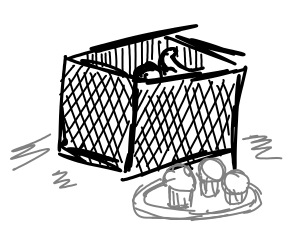
It is the Sunday before the beginning of exams, and the weather is spectacular. Most students (except perhaps the pure historians) are dourly inside, too busy revising to take advantage of it. But I am thrust out of my den, constructed of piles of notes and past exam questions, in order to go to one final revision with our history supervisor, Mirjam. I cycle down Grange road, park my bicycle outside Ridley Hall, and am greeted to a pleasant surprise: Mirjam has elected to hold the revision outside on a cluster of park benches flanked everywhere by grass and trees, and has brought a wickerbasket containing fresh fruit, small cupcakes and other treats, and also sparkling wine and beer (perhaps not the best drink for what is ostensibly a revision, but we avail ourselves of it anyway.)
Read more...
I use Mendeley because it lets me easily search for papers I care about. Unfortunately, that seems to be all Mendeley has been doing for me… and that’s a damn shame. Maybe it’s because I’m an undergraduate, still dipping my toe into an ocean of academic research. Mendeley was aimed at practicing researchers, but not people like me, who are stilll aiming for breadth not depth. I can count on two hands the number of technical papers I’ve really dug into—I’m trying to figure out what it is exactly that I want to specialize in.
Read more...
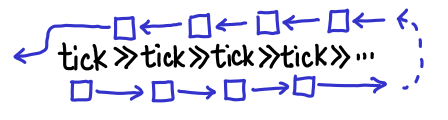
The first thing to convince yourself of is that there actually is a problem with the code I posted last week. Since this is a memory leak, we need to keep track of creations and accesses of IVars. An IVar allocation occurs in the following cases for our example:
- Invocation of
return, which returns a full IVar, - Invocation of
tick, which returns an empty IVar and schedules a thread to fill this IVar, and - Invocation of
>>=, which returns an empty IVar and a reference to this IVar in the callback attached to the left-hand IVar.
An IVar access occurs when we dereference an IORef, add a callback or fill the IVar. This occurs in these cases:
Read more...
One downside to the stupid scheduler I mentioned in the previous IVar monad post was that it would easily stack overflow, since it stored all pending operations on the stack. We can explicitly move all of these pending callbacks to the heap by reifying the execution schedule. This involves adding Schedule state to our monad (I’ve done so with IORef Schedule). Here is a only slightly more clever scheduler (I’ve also simplified some bits of code, and added a new addCallback function):
Read more...
An IVar is an immutable variable; you write once, and read many times. In the Par monad framework, we use a prompt monad style construction in order to encode various operations on IVars, which deterministic parallel code in this framework might use. The question I’m interested in this post is an alternative encoding of this functionality, which supports nondeterministic concurrency and shows up in other contexts such as Python Twisted, node.js, any JavaScript UI library and LWT. Numerous bloggers have commented on this. But despite all of the monad mania surrounding what are essentially glorified callbacks, no one actually uses this monad when it comes to Haskell. Why not? For one reason, Haskell has cheap and cheerful preemptive green threads, so we can write our IO in synchronous style in lots of threads. But another reason, which I will be exploring in a later blog post, is that naively implementing bind in this model space leaks! (Most event libraries have worked around this bug in some way or another, which we will also be investigating.)
Read more...
Today I would like to describe how I pin down compiler bugs, specifically, bugs tickled by optimizations, using a neat feature that Hoopl has called optimization fuel. Unfortunately, this isn’t a particularly Googleable term, so hopefully this post will get some Google juice too. Optimization fuel was originally introduced by David Whalley in 1994 in a paper Automatic isolation of compiler errors. The basic idea is that all optimizations performed by the compiler can be limited (e.g. by limiting the fuel), so when we suspect the optimizer is misbehaving, we binary search to find the maximum amount of fuel we can give the compiler before it introduces the bug. We can then inspect the offending optimization and fix the bug. Optimization fuel is a feature of the new code generator, and is only available if you pass -fuse-new-codegen to GHC.
Read more...
This post describes how to change which monitor xmobar shows up on in a multi-monitor setup. This had always been an annoyance for me, since on an initial switch to multi-monitor, xmobar would be living on the correct monitor, but if I ever restarted XMonad thereafter, it would migrate to my other monitor, much to my annoyance. Note that a monitor is different from an X screen, which can be directly configured from xmobar using the -x command line.
Read more...
This is notebook two.
Max Schäfer: Refactoring Java
Most Java refactoring tools built into IDEs like Eclipse are little more than glorified text manipulation macros. There are no guarantees that the result of your refactoring will have the same behavior as the original: you can even refactor code that doesn’t even compile! To prevent this, most refactorings require heavy and hard-to-understand preconditions for refactoring. Max brings two ideas to the table:
Read more...
Over the year, I’ve accumulated three notebooks worth of miscellaneous notes and musings. Since these notebooks are falling apart, I’ve decided to transfer their contents here. Warning: they might be slightly incoherent! This is the first of three notebooks. I recommend skimming the section headers and seeing if any of them pop out.
Tony Hoare: Abstract Separation Algebra
Tony Hoare wants to leverage “the hard work [that] is already solved” by placing the formalism of separation logic (e.g. Hoare triples) into an abstract algebra. The idea is that by encoding things in pairs, not triples, we can take advantage of the numerous results in algebra. The basic idea is we take a traditional triple {p} q {r} and convert it into a ordered semigroup relation p; q <= r, where ; is a monoidal operation. In the end we end up with a separation algebra, which is a monoidal lattice with an extra star operator. The choice of axioms is all: “This is abstract algebra, so you should be willing to take these axioms without having any model in mind.” (Scribbled here: “Inception as a metaphor for mathematical multi-level thinking.”) We have a homomorphism (not isomorphism) between implementations and specifications (the right direction is simplification, the left direction is a Galois connection.) In fact, as a commenter in the audience points out, this is known as the Stone Dualities—something like how two points determine a line—with contravariant points and properties. I believe Tony’s been thinking about this topic a bit since I went to this talk at the very beginning of this year, so its likely some or all of this has been superseded by later discoveries. C’est la vie!
Read more...
I recently encountered the following pattern while writing some Haskell code, and was surprised to find there was not really any support for it in the standard libraries. I don’t know what it’s called (neither did Simon Peyton-Jones, when I mentioned it to him), so if someone does know, please shout out. The pattern is this: many times an endomorphic map (the map function is a -> a) will not make very many changes to the underlying data structure. If we implement the map straight-forwardly, we will have to reconstruct the entire spine of the recursive data structure. However, if we use instead the function a -> Maybe a, we can reuse old pieces of the map if there were no changes to it. (Regular readers of my blog may recognize this situation from this post.) So what is such an alternative map (a -> Maybe a) -> f a -> Maybe (f a) called?
Read more...