April 26, 2010Tagline: Assertions considered not ideal.
I think automated tests are great. I used two particular flavors of test, the unit test and the integration test, extensively in HTML Purifier and they’re the only reason why I feel comfortable making changes to code that I first wrote in High School. The automated tests let me hack and then figure out if I broke anything with the single stroke of a button, rather than manually shove a few inputs in and see if they “look alright.” They’re also an informal specification of “what I wanted the code to do” when I originally wrote it, by the fine tradition of an example.
Both unit tests and integration tests were built on top of the SimpleTest “unit testing” library. I place the “unit testing” in quotes because, while SimpleTest is great for unit testing (the testing of individual components), it also can be used for integration testing (the testing of multiple components together) and system testing (the entire system, for web applications this commonly involves writing scripts to navigate the website); in fact, it has facilities in place to make the latter two easier to do!
Perhaps a more accurate description of SimpleTest as a whole is that it is a descendant of the xUnit testing framework. You know, the “make a test function that sets some stuff up, runs some code, and makes some asserts” style of testing. The idea of an assertion is essential; sans exception handling, that’s your single portal into whether or not the test code failed or succeeded.
I was writing some tests in JUnit the other day, and it reminded me a little bit why, even though automated tests are great, I’m somewhat reluctant to roll them out in the first place. They’re so verbose! Every test method I have to instantiate whatever class I want, do whatever initialization I need to it, create my input data (if I’m directly building it with new, this can easily take several lines), run the function, and then test if the output data is what I expected (either by laborious poking at the various fields and methods in it or, if I had the foresight to implement equality, construct the expected output result and compare them.) “But wait,” you say, “that’s precisely what setUp and tearDown are for!” and then you move chunks of this code into those methods, but the substantial bits of boilerplate for creating inputs and verifying results remain, and you are terrified of abstracting over them because adding more code means there’s more chance for your test to be wrong!
But there’s not a good way out of this mess, because the list of function calls to the unit under test is truly the “input” to your test suite, and then list of expressions passed into the assertions is truly the “output” of your test suite. The particular assertion you choose to use is the “expected value” of your test suite. So why does it feel like boilerplate?
Maybe because the model of setUp and tearDown methods and test methods and assertions is the wrong one for many types of code: the correct model is the input value, output value and expected value model! And for pure code, the code that actually has a more refined notion of its input and its output than “a code listing” and “the global state of the application after you ran the code listing”; maybe it truly is just “two integers” and “an integer.” And then, the test code you write should actually reflect that!
So how do we make this happen? You want a DSL. Some languages are strong enough that you can get away with an embedded DSL of sorts. But many languages make this too cumbersome, so they invent their own test format and write the necessary boilerplate code to parse it and marshal it around. Obviously there need to be enough tests of this form to make writing all of this infrastructure worthwhile, and so when that’s not true people fall back to the quick and dirty xUnit style of testing. But by doing this, you’ve obscured the shape of your test, and since “quick and dirty” never means “ephemeral”, your test suite grows and grows and you never end up cutting over to the right way. Ever.
At this point, it’s about time for a little Haskell advocacy. How can you make your tests lest cumbersome from the get go? Use a language that encourages the construction mini-DSLs. Haskell has flexible syntax and type facilities to make this doable, check. Use a language that encourages you to think carefully about functions, which have clear inputs and outputs, not classes and methods and mutable state. Haskell is a functional programming language, check. Use a language in which abstraction is cheap and boilerplate is killed with fire. Haskell, check. Use a language that, once you’ve gotten tired of writing input and output values over and over again, and not the boilerplate of an entire xUnit test case, gives you the rope to automate that process too! QuickCheck and Haskell, check.
It’s also time for a little call to action: don’t conflate the unit/acceptance/system testing hierarchy with the xUnit framework/boilerplate. There’s xUnit testing and then there’s fully randomized input generation ala QuickCheck, but there’s still room in-between these two distinct places in abstraction for people and tests to live. And of course, the xUnit style test can be useful when a code listing truly is the right paradigm for the input representation.
April 23, 2010The bag of programming tricks that has served us so well for the last 50 years is the wrong way to think going forward and must be thrown out.
Last week, Guy Steele came in and did a guest lecture “The Future is Parallel: What’s a Programmer to Do?” for my advanced symbolic class (6.945). It’s a really excellent talk; such an excellent talk that I had seen the slides for prior to the talk. However hearing Guy Steele talk about it in person really helped set things in context for me.
One of the central points of the talk is the call for more creative catamorphisms. Well, what is a creative catamorphism? To answer this question, we first have to understand what a catamorphism is. The functional programming crowd is well familiar with a few relatively banal examples of the catamorphism, namely the left fold and the right fold. One way to think about folds is simply a “level of abstraction” above a loop one might write in an imperative language. Another way to think of the fold is replacing the type constructor for the list (the cons or : operation) with another function, as seen in Cale Gibbard’s excellent diagrams:

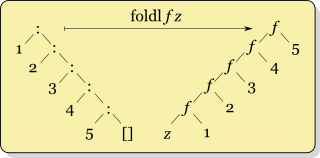
The point of the catamorphism is that this doesn’t need to apply just to lists; in fact, we can run a catamorphism on any recursive data structure! Just make a function for each constructor in the type, with the appropriate arity (so a ternary tree would require functions that take three arguments, and so forth), and let her rip! This is vitally important because the old left and right fold are the “wrong way to think”; by the very nature of their structure they require you to evaluate sequentially. But set things up in a binary tree, and you can evaluate all the subtrees first before combining them at the end.
So what is a creative catamorphism? It’s when the original recursive data structure doesn’t map cleanly on to the atoms that your computation wants to deal with. The example Guy Steele discusses in his talk is the time honored task of breaking a string into its words. A string is merely a list of characters, which only lets us handle it character by character (traditional sequential), or a naive transformation into a binary tree, which only gives us efficient bisection (parallelizable). The trouble with naive bisection is that it might split in the middle of the word, so our combining function has to account for this case. How to deal with this is left as an exercise for the reader (or you can go read the slides.)
In fact, this was the critical moment when I understood the global reasoning behind what Edward Kmett was talking about when he gave his (in my opinion pretty crazy) talk on “A Parallel Parsing Trifecta: Iteratees, Parsec, and Monoids”. The goal of this code is to massively parallelize parsing by splitting up the input document into chunks and then recombining them with the parsing function. He has to deal with the same problems that showed up in the toy example in Steele’s talk, and he pulls out all sorts of tricks to get things pumping.
I will admit, the work is complicated, and at times, it feels like overkill. But it’s a brave new parallel world, and it’s time we fully explore the designs and implications of it. With any luck, we will be able to write parallel programs as naturally we can write sequential programs, but it’s a long way getting there.
Update (2013-05-21). Oleg writes in to tell me that there is actually a name for these types of tricks: an almost homomorphism. It is not surprising to see that the work described in the Skepara project collaborated with Guy Steele and the Fortress project; it is well worth checking out for a calculational approach for deriving these catamorphisms.
April 21, 2010I recently some did some benchmarking of persistent data structures in mit-scheme for my UROP. There were a few questions we were interested in:
- For what association sizes does a fancier data structure beat out your plain old association list?
- What is the price of persistence? That is, how many times slower are persistent data structures as compared to your plain old hash table?
- What is the best persistent data structure?
These are by no means authoritative results; I still need to carefully comb through the harness and code for correctness. But they already have some interesting implications, so I thought I’d share. The implementations tested are:
All implementations use eq? for key comparison.
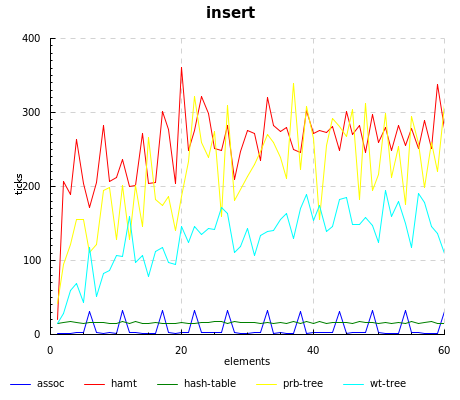
Unsurprisingly, assoc beats out everyone else, since all it has to do is a simple cons. However, there are some strange spikes at regular intervals, which I am not sure of the origin; it might be the garbage collector kicking in.
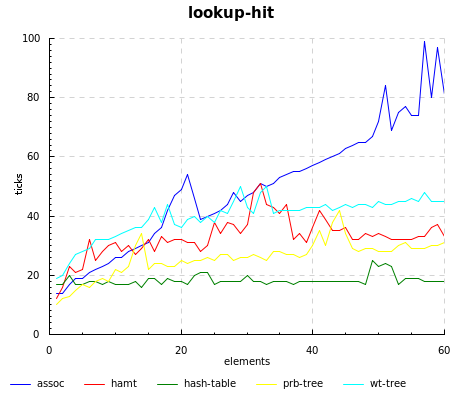
Of course, you pay back the cheap updates in assoc with a linear lookup time; the story also holds true for weight-balanced trees, which have fast inserts but the slowest lookups.
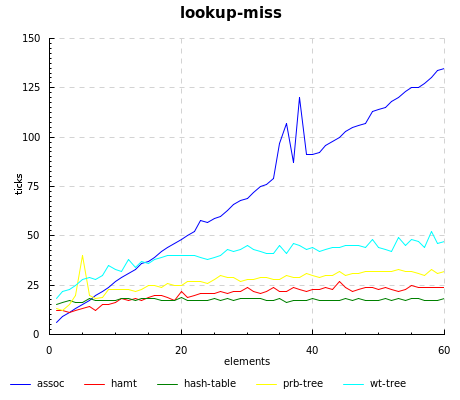
The hamt really flies when the key isn’t present, even beating out hash-tables until 15 elements or so.
Source code for running the benchmarks, our home-grown implementations, and graphing can be found at the scheme-hamt repository.
April 19, 2010In today’s world of social news aggregation websites, ala Reddit, Digg, Slashdot, it is rare for the sole dialog between an author and a reader to take place on a private channel or on one’s website. I discovered this rather bluntly when I found that a document I had written had amassed a number of comments, one of which pointed out an error in what I had written, and then failed to notify me.
These days, there is a certain amount of savvy that needs to be exercised in order to keep track of references on the Internet. Google Alerts, Twitter search, pingbacks… the list goes on and on. If you want to engage in a conversation with someone on the Internet, you’ll probably have to go to the medium they responded on, abide by the social conventions of that site and also risk being totally ignored (although that’s not as bad, since “you got the last word.”) If you’re a small company working carefully to cultivate good public relations around your product, you may even go as far to track down someone’s online identity and send them an email asking them if there’s any way you can help (it has been described as “creepily awesome customer service.”)
Then there’s also the flip side of the coin: to engage in a dialog with your reader, they need to know when you’ve responded! If they commented on their favorite social news site, they’ll get an update stream aggregating all of the other discussions they may be participating in. If they commented on the blog itself, options are far more varied: some blogs (like mine) offer no mechanism of notification when replies have been posted; others may offer “email notifications of replies” but fail to distinguish threads of conversation; some even outsource their discussion to a third-party provider like Disqus.
There are, of course, some who have lost faith in statesmanship over the Internet. Those are the people who you’ll see post essays with only a private email link for one-to-one conversation; those are the people who force their readers to unsponsored discussion on their favorite social media website; those are the people who shake their heads when the an ignorant commenter fails to display any indication that they read the article or know what they are talking about. I think that we can do better, because I’ve seen better! (Wink.) I’ve seen people comment, not because they want to project an image of smugness or superior knowledge, but because there is an earnest dialogue going on between all parties which, most of all, is focused on the transfer of knowledge. I’ve seen it happen on the Internet; I’ve seen it happen in real life; I still fall victim to the impulse to posture and chest-beat. I prefer conversing to people when the goal is to communicate, and not to win an argument. I enjoy arguing with people when I feel there is as much listening happening as there is talking. I love having an audience that consists of people, not an anonymous Internet.
April 16, 2010Conductor and violinist Gustavo Dudamel will be visiting MIT today to accept the Eugene McDermott Award in the Arts. Part of the awards ceremony will include a session with Dudamel conducting the MIT Symphony Orchestra; I’ll be on stage playing Oboe and English Horn on Rimsky Korsakov and Mozart. Our regular conductor (Adam Boyles) has been prepping us for this by taking, erm, unusual liberties in tempo and phrasing.
I’m not usually very aware of names of conductors, but I have heard Dudamel’s float across WQXR on occasion. The evening promises to be exciting.
Non sequitur. You can join PDF files together using pdftk input1.pdf input2.pdf input3.pdf cat output output.pdf. You can also use GhostScript, but this results in quality degradation since the file gets converted to PostScript first. (This may also explain why we keep finding 2.5GB PostScript files filling up our server disks.)
April 14, 2010data-accessor is a package that makes records not suck. Instead of this code:
newRecord = record {field = newVal}
You can write this:
newRecord = field ^= newVal
          $ record
In particular, (field ^= newVal) is now a value, not a bit of extra syntax, that you can treat as a first-class citizen.
I came across this module while attempting to use Chart (of criterion fame) to graph some data. I didn’t recognize it at first, though; it was only after playing around with code samples did I realize that ^= was not a combinator that Chart had invented for its own use (as opposed to the potpourri of -->, <+>, ||| and friends you might see in an xmonad.hs). When utilized with Template Haskell, Data.Accessor represents something of a replacement for the normal record system, and so it’s useful to know when a module speaks this other language. Signs that you’re in a module using Data.Accessor:
- Use of the
^= operator in code samples - All of the records have underscores suffixed, such as
plot_lines_title_ - Template Haskell gobbledygook (including type variables that look like
x[acGI], especially in the “real” accessors that Template Haskell generated). - Unqualified
T data types floating around. (As Brent Yorgey tells me, this is a Henning-ism in which he will define a type T or typeclass C intended to be used only with a qualified import, but Haddock throws away this information. You can use :t in GHC to get back this information if you’re not sure.)
Once you’ve identified that a module is indeed using Data.Accessor, you’ve won most of the battle. Here is a whirlwind tutorial on how to use records that use data-accessor.
Interpreting types. An accessor (represented by the type Data.Accessor.T r a) is defined to be a getter (r -> a) and setter (a -> r -> r). r is the type of the record, and a is the type of the value that can be retrieved or set. If Template Haskell was used to generate the definitions, polymorphic types inside of a and r will frequently be universally quantified with type variables that x[acGI], don’t worry too much about them; you can pretend they’re normal type variables. For the curious, these are generated by the quotation monad in Template Haskell).
Accessing record fields. The old way:
fieldValue = fieldName record
You can do things several ways with Data.Accessor:
fieldValue = getVal fieldname record
fieldValue = record ^. fieldname
Setting record fields. The old way:
newRecord = record {fieldName = newValue}
The new ways:
newRecord = setVal fieldName newValue record
newRecord = fieldName ^= newValue $ record
Accessing and setting sub-record fields. The old ways:
innerValue = innerField (outerField record)
newRecord = record {
  outerField = (outerField record) {
    innerField = newValue
  }
}
The new ways (this is bit reminiscent of semantic editor combinators):
innerValue = getVal (outerField .> innerField) record
newRecord = setVal (outerField .> innerField) newValue record
There are also functions for modifying records inside the state monad, but I’ll leave those explanations for the Haddock documentation. Now go forth and, erm, access your data in style!
April 12, 2010Earlier in January, I blogged some first impressions about the VX-8R. It’s now three months later, and I’ve used my radio on some more extensive field tests. I’m considering selling my VX-8R for a 7R, for the following reasons:
- I generally need five hours of receive with medium transmission. I only get about 3.5 hours worth of receive with the standard VX-8R battery. This is not really acceptable. (At risk of being “get off my lawn”, Karl Ramm comments that his old Icom W32 from the 90s got 12 hours of receive.)
- The AA battery adapter is laughable, giving maybe 20min of receive time before flagging. The ability to run digital cameras on AA batteries had given me the false impression that I’d be able to do the same for a radio, really this adapter is only fit for emergency receive situations.
- The remaining battery indicator unreliable, going from 8.5V to 7.5V, and then dropping straight to zero. This is the defect I sent mine back in for last time, but I saw this problem in the replacement, and a friend confirmed that he saw the same on his.
- The radio gets quite hot during operation. I’d never noticed the temperature with the 7R.
- Everyone else around here owns a 7R, which severely limits the swappability of various components (in particular, batteries).
I really am going to miss the dedicated stereo jack and slimmer (and, in my opinion, better) interface, but these really are deal breakers. C’ést la vie.
April 9, 2010Two people have asked me how drew the diagrams for my previous post You Could Have Invented Zippers, and I figured I’d share it with a little more elaboration to the world, since it’s certainly been a bit of experimentation before I found a way that worked for me.
Diagramming software for Linux sucks. Those of you on Mac OS X can churn out eye-poppingly beautiful diagrams using OmniGraffle; the best we can do is some dinky GraphViz output, or maybe if we have a lot of time, a painstakingly crafted SVG file from Inkscape. This takes too long for my taste.
So, it’s hand-drawn diagrams for me! The first thing I do is open my trusty Xournal, a high-quality GTK-based note-taking application written by Denis Auroux (my former multivariable calculus professor). And then I start drawing.
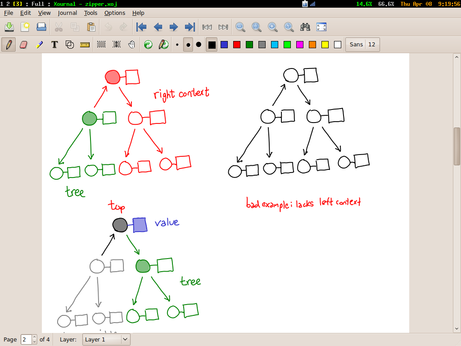
Actually, that’s not quite true; by this time I’ve spent some time with pencil and paper scribbling diagrams and figuring out the layout I want. So when I’m on the tablet, I have a clear picture in my head and carefully draw the diagram in black. If I need multiple versions of the diagram, I copy paste and tweak the colors as I see fit (one of the great things about doing the drawing electronically!) I also shade in areas with the highlighter tool. When I’m done, I’ll have a few pages of diagrams that I may or may not use.
From there, it’s “File > Export to PDF”, and then opening the resulting PDF in Gimp. For a while, I didn’t realize you could do this, and muddled by using scrot to take screen-shots of my screen. Gimp will ask you which pages you want to import; I import all of them.
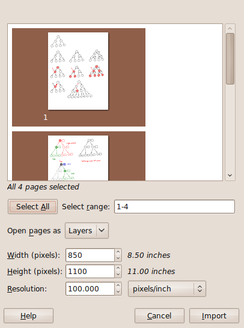
Each page resides on a separate “layer” (which is mildly useless, but not too harmful). I then crop a logical diagram, save-as the result (asking Gimp to merge visible layers), and then undo to get back to the full screen (and crop another selection). When I’m done with a page, I remove it from the visible layers, and move on to the next one.
When it’s all done, I have a directory of labeled images. I resize them as necessary using convert -resize XX% ORIG NEW and then dump them in a public folder to link to.
Postscript. Kevin Riggle reminds me not to mix green and red in the same figure, unless I want to confuse my color blind friends. Xournal has a palette of black, blue, red, green, gray, cyan, lime, pink, orange, yellow and white, which is a tad limiting. I bet you can switch them around, however, by mucking with predef_colors_rgba in src/xo-misc.c
April 7, 2010In the beginning, there was a binary tree:
struct ctree { // c for children
  int val;
  struct ctree *left;
  struct ctree *right;
}
The flow of pointers ran naturally from the root of the tree to the leaves, and it was easy as blueberry pie to walk to the children of a node.
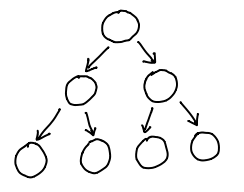
Unfortunately, given a node, there was no good way to find out its parent! If you only needed efficient parent access, though, you could just use a single pointer in the other direction:
struct ptree { // p for parent
  int val;
  struct ptree *parent;
}
The flow of pointers then ran from the leaves of the tree to the root:
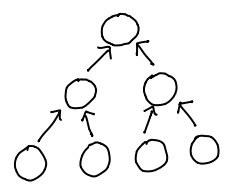
And of course, put together, you could have the best of both worlds:
struct btree {
  int val;
  struct btree *parent;
  struct btree *left;
  struct btree *right;
}
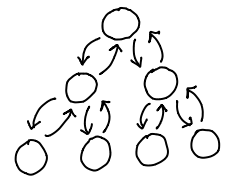
Our data structure had become circular, but as a result we had extremely efficient ways to walk up and down the tree, as well as insert, delete and move nodes, simply by mutating the relevant pointers on our node, its children and its parent.
Trouble in paradise. Pointer tricks are fine and good for the mutable story, but we want immutable nodes. We want nodes that won’t change under our nose because someone else decided to muck around the pointer.
In the case of ctree, we can use a standard practice called path copying, where we only need to change the nodes in the path to the node that changed.
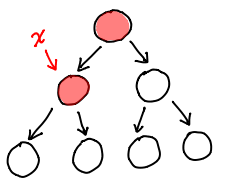
In fact, path copying is just a specific manifestation of the rule of immutable updates: if you replace (i.e. update) something, you have to replace anything that points to it, recursively. In a ptree, we’d need to know the subtree of the updated node and change all of them.
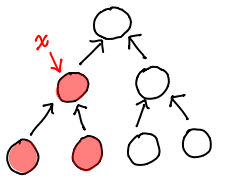
But btree fails pretty spectacularly:
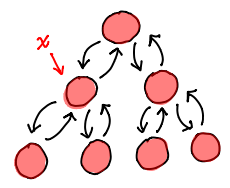
Our web of pointers has meant we need to replace every single node in the tree! The extra circular pointers work to our detriment when looking for a persistent update.
What we’d like to do is somehow combine the ptree and the ctree more intelligently, so we don’t end up with a boat of extra pointers, but we still can find the children and the parent of a node.
Here, we make the critical simplifying assumption: we only care about efficient access of parents and children as well as updates of a single node. This is not actually a big deal in a world of immutable data structures: the only reason to have efficient updates on distinct nodes is to have a modification made by one code segment show up in another, and the point of immutability is to stop that spooky action at a distance.
So, on a single node, we want fast access to the parent and children and fast updates. Fast access means we need pointers going away from this node, fast updates means we need to eliminate pointers going into this node.
Easy! Just flip some pointers (shown in red.)
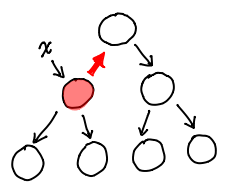
Congratulations, the data structure you see here is what we call a zipper! The only task left for us now is to figure out how we might actually encode this in a struct definition. In the process, we’ll assign some names to the various features inside this diagram.
Let’s consider a slightly more complicated example:
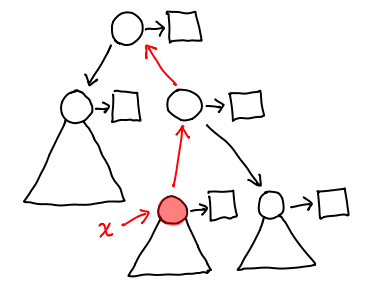
We’ve introduced a few more notational conveniences: triangles represent the tree attached to a given node when we don’t care about any of its subnodes. The squares are the values attached to any given node (we’ve shown them explicitly because the distinction between the node and its data is important.) The red node is the node we want to focus around, and we’ve already gone and flipped the necessary pointers (in red) to make everything else accessible.
When we’re at this location, we can either traverse the tree, or go up the red arrow pointed away from the green node; we’ll call the structure pointed to by this arrow a context. The combination of a tree and a context gives us a location in the zipper.
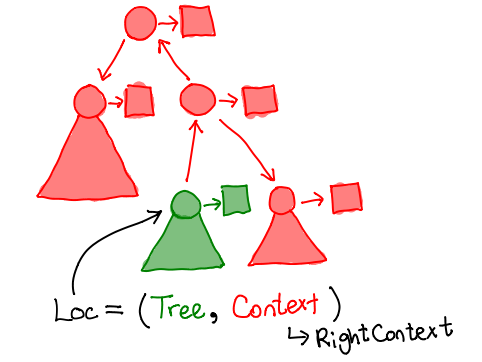
struct loc {
  struct ctree *tree;
  struct context *context;
}
The context, much like the tree, is a recursive data-structure. In the diagram below, it is precisely the node shaded in black. It’s not a normal node, though, since it’s missing one of its child pointers, and may contain a pointer to its own parent.
The particular one that this location contains is a “right context”, that is, the arrow leading to the context points to the right (shown in black in the following diagram).
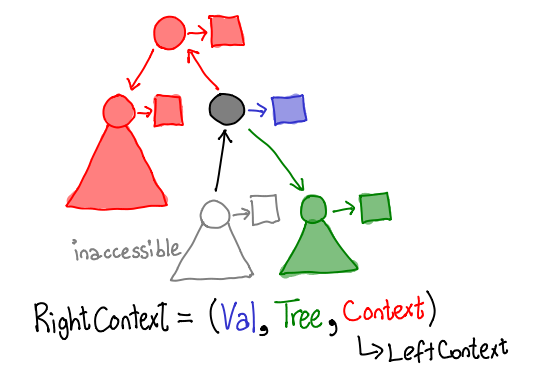
As you can see, for our tree structure, a context contains another context, a tree, and a value.
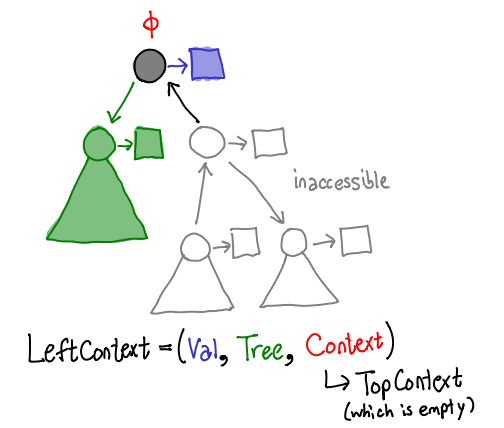
Similarly, a “left context” corresponds to an arrow pointing to the left. It contains the same components, although it may not be quite obvious from the diagram here: where’s the recursive subcontext? Well, since we’re at the top of the tree, instead we have a “top context”, which doesn’t contain any values. It’s the moral equivalent of Nothing.
enum context_type {LEFT, RIGHT, TOP}
struct context {
  enum context_type type;
  // below only filled for LEFT and RIGHT
  int val;
  struct context *context;
  struct ctree *tree;
}
And there we have it! All the pieces you need to make a zipper:
> data Tree a = Nil | Node a (Tree a) (Tree a)
> data Loc a = Loc (Tree a) (Context a)
> data Context a = Top
>                | Left a (Tree a) (Context a)
>                | Right a (Tree a) (Context a)
Exercises:
- Write functions to move up, down-left and down-right our definition of
Tree. - If we had the alternative tree definition
data Tree a = Leaf a | Branch Tree a) (Tree a), how would our context definition change? - Write the data and context types for a linked list.
Further reading: The original crystallization of this pattern can be found in Huet’s paper (PDF), and two canonical sources of introductory material are at Wikibooks and Haskell Wiki. From there, there is a fascinating discussion about how the differentiation of a type results in a zipper! See Conor’s paper (PDF), the Wikibooks article, and also Edward Kmett’s post on using generating functions to introduce more exotic datatypes to the discussion.
April 5, 2010zip: List<A>, List<B> -> List<(A, B)>
zip(Nil, Nil) = Nil
zip(_, Nil) = Nil
zip(Nil, _) = Nil
zip(Cons(a, as), Cons(b, bs)) = Cons((a, b), zip(as, bs))
fst: (A, B) -> A
fst((a, _)) = a
last: List<A> -> A
last(Cons(a, Nil)) = a
last(Cons(a, as)) = last(as)
foldl: (B, A -> B), B, List<A> -> B
foldl(_, z, Nil) = z
foldl(f, z, Cons(x, xs)) = foldl(f, f(z, x), xs)
Good grief Edward, what do you have there? It’s almost as if it were some bastardized hybrid of Haskell, Java and ML.
It actually is a psuedolanguage inspired by ML that was invented by Daniel Jackson. It is used by MIT course 6.005 to teach its students functional programming concepts. It doesn’t have a compiler or a formal specification (although I hear the TAs are frantically working on one as a type this), though the most salient points of its syntax are introduced in lecture 10 (PDF) when they start discussing how to build a SAT solver.
Our second problem set asks us to write some code in this pseudolanguage. Unfortunately, being a pseudolanguage, you can’t actually run it… and I hate writing code that I can’t run. But it certainly looks a lot like Haskell… just a bit more verbose, that’s all. I asked the course staff if I could submit the problem set in Haskell, and they told me, “No, since the course staff doesn’t know it. But if it’s as close to this language as you claim, you could always write it in Haskell and then translate it to this language when you’re done.”
So I did just that.
The plan wouldn’t really have been possible without the existence of an existing pretty printer for Haskell to do most of the scaffolding for me. From there, it was mucking about with <>, lparen and comma and friends in the appropriate functions for rendering data-types differently. Pretty printing combinators rock!