Earlier this year, Woodie Flowers wrote this criticism of MITx:
We seem to have decided to offer “courses” rather than participate in the exciting new process of replacing textbooks with more effective training tools.
Logitext, true to its name, was intended to explore what a chapter from a next-generation textbook on formal logic might look like. But if you asked anyone what subjects the most important textbooks of this century would be about, I doubt logic would be particularly high on anyone’s list. In terms of relevance, Logitext misses the mark. But I do think there are some design principles that Logitext helps elucidate.
Read more...
You can view it here: An Interactive Tutorial of the Sequent Calculus. This is the “system in three languages” that I was referring to in this blog post. You can also use the system in a more open ended fashion from this page. Here’s the blurb:
This interactive tutorial will teach you how to use the sequent calculus, a simple set of rules with which you can use to show the truth of statements in first order logic. It is geared towards anyone with some background in writing software for computers, with knowledge of basic boolean logic.
Read more...
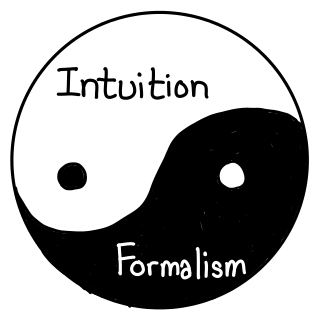
Note: this is not a discussion of Hilbert’s formalism versus Brouwer’s intuitionism; I’m using formalism and intuition in a more loose sense, where formalism represents symbols and formal systems which we use to rigorously define arguments (though not logic: a sliding scale of rigor is allowed here), while intuition represents a hand-wavy argument, the mental model mathematicians actually carry in their head.
Formalism and intuition should be taught together.
Read more...
The You could have invented… article follows a particular scheme:
- Introduce an easy to understand problem,
- Attempt to solve the problem, but get stuck doing it the “obvious” way,
- Introduce an easy to understand insight,
- Methodically work out the rest of the details, arriving at the final result.
Why does framing the problem this way help?
- While the details involved in step 4 result in a structure which is not necessarily obvious (thus giving the impression that the concept is hard to understand), the insight is very easy to understand and the rest is just “monkey-work”. The method of deriving the solution is more compressible than the solution itself, so it is easier to learn.
- Picking a very specific, easy-to-understand problem helps ground us in a concrete example, whereas the resulting structure might be too general to get a good intuition off of.
It’s very important that the problem is easy to understand, and the process of “working out the details” is simple. Otherwise, the presentation feels contrived. This method is also inappropriate when the audience is in fact smart enough to just look at the end-result and understand on an intuitive level what is going on. Usually, this is because they have already seen the examples. But for the rest of us, it is a remarkably effective method of pedagogy.
Read more...
Edward continues his spree of systems posts. Must be something in the Boston air.
Yesterday, I gave a SIPB cluedump on the use and implementation of scripts.mit.edu, the shared host service that SIPB provides to the MIT community. I derive essentially all of my sysadmin experience points from helping maintain this service.
Scripts is SIPB’s shared hosting service for the MIT community. However, it does quite a bit more than your usual $10 host: what shared hosting services integrate directly with your Athena account, replicate your website on a cluster of servers managed by Linux-HA, let you request hostnames on *.mit.edu, or offer automatic installs of common web software, let you customize it, and still upgrade it for you? Scripts is a flourishing development platform, with over 2600 users and many interesting technical problems.
Read more...
I’ve had a rather successful tenure with autogenerated documentation, both as a writer and a reader. So when Jacob Kaplan Moss’s articles on writing “great documentation” resurfaced on Reddit and had some harsh words about auto-generated documentation, I sat back a moment and thought about why autogenerated documentation leave developers with a bad taste in their mouths.
I interpreted Moss’s specific objections (besides asserting that they were “worthless” as the following:
Read more...
Attention conservation notice. The author reminisces about learning physics in high school, and claims that all too often, teaching was focused too much on concrete formulas, and not the unifying theory around them.
In elementary school, you may have learned D=RT (pronounced “dirt”), that is, distance is rate multiplied with time. This was mostly lies, but it was okay, because however tenuous the equation’s connection to the real world, teachers could use it to introduce the concept of algebraic manipulation, the idea that with just D=RT, you could also find out R if you knew D and T, and T if you knew D and R. Unless you were unusually bright, you didn’t know you were being lied to; you just learned to solve the word problems they’d give you.
Read more...
Last February, I posted about classes that I was going to be taking. Here are some reflections, now that final projects and examinations are over.
6.005: Software Construction. Teaching students how to engineer large software projects is one of the oddest paradoxes that you might encounter in academic life. The institute is certainly capable of teaching concepts, tools and methodologies, but, to actually be capable of constructing a system from scratch? It’s not really something you can learn, it something that you have to do. And the amount of work you have to put in to start getting the taste of real code as opposed to school code (which gets thrown away at the end of the term) doesn’t fit into one term. We’ve joked that MIT ought to have a two part series, where the second part you are asked to go modify some code you wrote a year ago in the face of shifting requirements. (Unfortunately, I suspect a large number of people will rewrite the thing: one of the problems of not actually being able to do large systems.)
Read more...
It is a truth universally acknowledged that if you really want a change put into an open source project, you submit a patch along with the bug report. Sure, you might complain that the average user doesn’t have any programming experience and that it’s unreasonable to expect them to learn some complex system and then figure out how to make the change they’re looking for, but you’re just not in the secret society of hacker enthusiasts who fix their own damn software and give back to the projects they use.
Read more...
It’s a sunny day in your advanced symbolic programming class. Your teacher has just started going over monads—in Scheme, though—and you sit in the back of the classroom snarking about little tidbits of knowledge you know from Haskell. Suddenly, the teacher says (quite earnestly too), “Edward here seems to know a lot about monads. Why don’t we have him come up and teach them to the class?” Suddenly, you’re up expounding types to people who have never used Haskell before and failing utterly to explain to people how the continuation monad works. Only after several iterations do you manage to partially rewrite the presentation in a form that doesn’t assume fluency in Haskell. You’ve fallen into the expert trap.
Read more...