In which Edward tells some stories about Cambridge and posts lots of pictures.
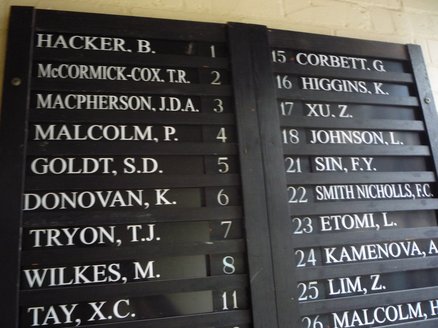
Apparently, Alyssa B. Hacker (sic) went on the Cambridge-MIT exchange.
This is perhaps a phenomenon of having been around MIT for too long, a campus which has a reputation for not being too picturesque (I can probably count the actually pretty spots on campus with one hand), but it’s real easy to stop appreciating how nice the buildings and architecture are around here. Look!
Read more...
…because I don’t live in a room numbered 245s anymore. Yep. :-)

This is a cow. They munch grass next to the River Cam.
Pop quiz. What do matrix-chain multiplication, longest common subsequence, construction of optimal binary search trees, bitonic euclidean traveling-salesman, edit distance and the Viterbi algorithm have in common?
I am a member of a group called the Assassins’ Guild. No, we don’t kill people, and no, we don’t play the game Assassin. Instead, we write and run competitive live action role-playing games: you get some game rules describing the universe, a character sheet with goals, abilities and limitations, and we set you loose for anywhere from four hours to ten days. In this context, I’d like to describe a situation where applying the rule Don’t Repeat Yourself can be harmful.
Read more...
I am studying computer science this academic year at Cambridge University, not MIT. For some people, this seems quite strange: when I tell old friends at MIT and new acquaintances at Cambridge about the fact that I am a Cambridge-MIT Exchange student, they say, “Why?” Sometimes, it’s some disbelief at the fact that I am choosing to leave the familiar social circles and situations that mark MIT. Other times, it’s some disbelief that I would want to study computer science at Cambridge rather than MIT (“Just joking,” they add, though I’m not necessarily sure I believe them.)
Read more...
For tomorrow I get on a plane traversing three thousand miles from my home to a little place named Cambridge, United Kingdom. I’ll be studying abroad for the 2010-2011 academic year at Cambridge University (specifically, I’ll be at Fitzwilliam college). While I know Baltimore is a fashionable place to be these days, if you’re in the area, drop me a line: I’d love to meet up after I get over my jet lag. :-)
Read more...
It’s 9:00AM, and the cell phone next to my pillow is vibrating ominously. I rise and dismiss the alarm before it starts ringing in earnest and peek out the window of my room.
Portland summer is a fickle thing: the weather of the first month of my internship was marked by mist and rain (a phenomenon, Don tells me, which is highly unusual for Portland), while the weather of the second month was a sleepy gray in the mornings. “Is it summer yet?” was the topic of #galois for most of July. But in the heart of August, summer has finally arrived, and the sun greets my gaze. Shorts and a T-shirt, no sweater necessary! I silently go “Yes!”
Read more...
What I did for my summer internship at Galois
World of algebra quizzes. As a high schooler, I was using concepts from computer science long before I even knew what computer science was. I can recall taking a math quiz—calculators banned—facing a difficult task: the multiplication of large numbers. I was (and still am) very sloppy when it came to pencil-and-paper arithmetic—if I didn’t check my answers, I would invariably lose points because of “stupid mistakes.” Fortunately, I knew the following trick: if I summed together the digits of my factors (re-summing if the result was ten or more), the product of these two numbers should match the sum of the digits of the result. If not, I knew I had the wrong answer. It wasn’t until much later that I discovered that this was a very rudimentary form of the checksum.
Read more...
A short thought from standing in line at the World Expo: Little’s law is a remarkable result that relates the number of people in a queue, the arrival rate of people to the queue, and the time spent waiting in the queue. It seems that it could be easily applied to a most universal feature of theme parks: waiting queues. Instead of such unreliable methods as giving visitors tokens to test how long it takes to traverse some portion of the line and then eyeballing the wait time from there, it would be a simple matter to install two gates: one to count incoming visitors and one to count outgoing visitors, and with this data derive an instantaneous “wait time in queue” figure based on a smoothed running average of queue size and arrival rate. Added benefit for being electronic, which means you can easily beam it to information boards across the park!
Read more...
This one’s for the MIT crowd.
I will unfortunately not be in Boston over IAP, so I won’t be able to do a redux of the class I taught last year, Advanced Typeclasses in Haskell. However, since I will be in Boston for September, it might be a good time to do cluedump for SIPB this year. I love talking about Haskell, and so I could do another talk in a similar vein (maybe something that covers rank-2 types and existential quantification?) I’ve also been thinking that doing an architectural overview of Scripts would also be good.
Read more...
Last February, I posted about classes that I was going to be taking. Here are some reflections, now that final projects and examinations are over.
6.005: Software Construction. Teaching students how to engineer large software projects is one of the oddest paradoxes that you might encounter in academic life. The institute is certainly capable of teaching concepts, tools and methodologies, but, to actually be capable of constructing a system from scratch? It’s not really something you can learn, it something that you have to do. And the amount of work you have to put in to start getting the taste of real code as opposed to school code (which gets thrown away at the end of the term) doesn’t fit into one term. We’ve joked that MIT ought to have a two part series, where the second part you are asked to go modify some code you wrote a year ago in the face of shifting requirements. (Unfortunately, I suspect a large number of people will rewrite the thing: one of the problems of not actually being able to do large systems.)
Read more...