data-accessor is a package that makes records not suck. Instead of this code:
newRecord = record {field = newVal}
You can write this:
newRecord = field ^= newVal
          $ record
In particular, (field ^= newVal) is now a value, not a bit of extra syntax, that you can treat as a first-class citizen.
I came across this module while attempting to use Chart (of criterion fame) to graph some data. I didn’t recognize it at first, though; it was only after playing around with code samples did I realize that ^= was not a combinator that Chart had invented for its own use (as opposed to the potpourri of -->, <+>, ||| and friends you might see in an xmonad.hs). When utilized with Template Haskell, Data.Accessor represents something of a replacement for the normal record system, and so it’s useful to know when a module speaks this other language. Signs that you’re in a module using Data.Accessor:
Read more...
In the beginning, there was a binary tree:
struct ctree { // c for children
  int val;
  struct ctree *left;
  struct ctree *right;
}
The flow of pointers ran naturally from the root of the tree to the leaves, and it was easy as blueberry pie to walk to the children of a node.
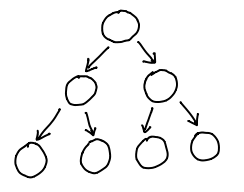
Unfortunately, given a node, there was no good way to find out its parent! If you only needed efficient parent access, though, you could just use a single pointer in the other direction:
Read more...
zip: List<A>, List<B> -> List<(A, B)>
zip(Nil, Nil) = Nil
zip(_, Nil) = Nil
zip(Nil, _) = Nil
zip(Cons(a, as), Cons(b, bs)) = Cons((a, b), zip(as, bs))

fst: (A, B) -> A
fst((a, _)) = a

last: List<A> -> A
last(Cons(a, Nil)) = a
last(Cons(a, as)) = last(as)

foldl: (B, A -> B), B, List<A> -> B
foldl(_, z, Nil) = z
foldl(f, z, Cons(x, xs)) = foldl(f, f(z, x), xs)
Good grief Edward, what do you have there? It’s almost as if it were some bastardized hybrid of Haskell, Java and ML.
Read more...
I’m happy to report that I’ll be interning at Galois over the summer. I’m not quite sure how the name of the company passed into my consciousness, but at some point in January I decided it would be really cool to work at an all-Haskell shop, and began pestering Don Stewart (and Galois’s HR) for the next two months.
I’ll be working on some project within Cryptol; there were a few specific project ideas tossed around though it’s not clear if they’ll have already finished one of my projects by the time the summer rolls around. I’m also really looking forward to working in an environment with a much higher emphasis towards research, since I need to figure out if I’m going to start gunning for a PhD program at the end of my undergraduate program.
Read more...
Code written by Anders Kaseorg.
In The Three Projections of Doctor Futamura, Dan Piponi treats non-programmers to an explanation to the Futamura projections, a series of mind-bending applications of partial evaluation. Go over and read it if you haven’t already; this post is intended as a spiritual successor to that one, in which we write some Haskell code.
The pictorial type of a mint. In the original post, Piponi drew out machines which took various coins, templates or other machines as inputs, and gave out coins or machines as outputs. Let’s rewrite the definition in something that looks a little bit more like a Haskell type.
Read more...
The fast, efficient association map has long been the holy grail of the functional programming community. If you wanted such an abstract data structure in an imperative language, there would be no question about it: you would use a hash table. But the fact that the hash table is founded upon the destructive update makes it hard to use with pure code.
What we are in search of is a strictly more powerful association map, one that implements a non-destructive update (i.e. is “persistent”). In the Haskell world, Data.Map is a reasonably compelling general-purpose structure that only requires the Ord typeclass on its keys. For keys that map cleanly on to machine-size integers, IntMap is an extremely fast purely functional that uses bit twiddling tricks on top of big-endian Patricia tries.
Read more...
Abstraction (n.) The act or process of separating in thought, of considering a thing independently of its associations; or a substance independently of its attributes; or an attribute or quality independently of the substance to which it belongs. (Oxford English Dictionary)
Abstraction is one of the most powerful beasts in the landscape of programming, but it is also one of the most elusive to capture. The places where abstraction may be found are many:
Read more...
Last week I talked about how we replaced a small C program with an equivalent piece of Haskell code. As much as I’d like to say that we deployed the code and there was much rejoicing and client side caching, the real story is a little more complicated than that. There were some really good questions that we had to consider:
How many maintainers at any given time know the language? The Scripts project is student-run, and has an unusually high turnover rate: any given maintainer is only guaranteed to be around for four to five years (maybe a little longer if they stick around town, but besides a few notable exceptions, most people move on after their time as a student). This means at any given point we have to worry about whether or not the sum knowledge of the active contributors is enough to cover all facets of the system, and facility in a language is critical to being able to administrate the component effectively (students we are, we frequently don both the sysadmin and developer hats). In a corporate setting, this is less prominent, but it still plays a factor: employees switch from one group to another and eventually people leave or retire. We have two current maintainers who are fairly fluent in Haskell. The long-term sustainability of this approach is uncertain, and hinges on our ability to attract prospective students who know or are interested in learning Haskell; in the worst case, people may crack open the code, say “what the fuck is this” and rewrite it in another language.
Read more...
The importance of constraint is one well known to those who embark on creative endeavors. Tell someone, “you can do anything you want: anything at all,” and they will blank, paralyzed by the infinite possibility. Artists welcome constraint. Writers like the constraint of a sonnet because it imposes form and gives a place to start; roleplaying groups like the constraint of a campaign setting because it imposes rules and sets the scene for the story to be told; jazz musicians like the constraint of the chords underlying an improvisation because it keeps the soloist anchored to the source tune and suggests ideas for the melody.
Read more...
C is the classic go-to tool for small programs that need to be really fast. When scripts.mit.edu needed a small program to be a glorified cat that also added useful HTTP headers to the beginning of its output, there was no question about it: it would be written in C, and it would be fast; the speed of our static content serving depended on it! (The grotty technical details: our webserver is based off of a networked filesystem, and we wanted to avoid giving Apache too many credentials in case it got compromised. Thus, we patched our kernel to enforce an extra stipulation that you must be running as some user id in order to read those files off the filesystem. Apache runs as it’s own user, so we need another small program to act as the go-between.)
Read more...