Move aside, poker! While the probabilities of various poker hands are well understood and tabulated, the Chinese game of chance Mahjong [1] enjoys a far more intricate structure of expected values and probabilities. [2] This is largely due in part to the much larger variety of tiles available (136 tiles, as opposed to the standard playing card deck size of 52), as well as the turn-by-turn game play, which means there is quite a lot of strategy involved with what is ostensibly a game of chance. In fact, the subject is so intricate, I’ve decided to write my PhD thesis on it. This blog post is a condensed version of one chapter of my thesis, considering the calculation of shanten, which we will define below. I’ll be using Japanese terms, since my favorite variant of mahjong is Riichi Mahjong; you can consult the Wikipedia article on the subject if you need to translate.
Read more...
Fall is coming, and with it come hoards of ravenous Freshmen arriving on MIT’s campus. I’ll be doing three food events… all of them functional programming puns. Whee!
Anamorphism: the building up of a structure. Catamorphism: the consumption of a structure. Hylomorphism: both an anamorphism and a catamorphism. This event? A hylomorphism on dumplings. Come learn the basic fold, or just perform a metabolic reduction on food.
Read more...
Yesterday we had guest speaker Byron Cook come in to give a talk about SLAM, a nice real-world example of theorem proving technology being applied to device drivers.
Having worked in the trenches, Byron had some very hilarious (and interesting) quips about device driver development. After all, when a device driver crashes, it’s not the device driver writer that gets blamed: it’s Microsoft. He pointed out that, in a hardware company, “If you’re not so smart, you get assigned to write software drivers. The smart people go work on hardware”, and that when you’re reading device driver code, “If there are a lot of comments and they’re misspelled, there’s probably a bug.” Zing! We’re always used to extolling the benefits of commenting your code, but it certainly is indisputable that writing comments can help clarify confusing code to yourself, whereas if the code wasn’t confusing in the first place you wouldn’t have felt the need to write comments anyway. Thus, one situation is some guru from the days of yore wrote very clever code, and then you came along and weren’t quite clever enough to fully understand what was going on, so you wrote lots of comments to explain the code to yourself as you went along. Well, it’s not the comment’s fault, but the fact that the code was too clever for you probably means you introduced a bug when you made your modifications.
Read more...
The perverse incentive structure of the Internet
Suppose you have a Random Question™ that you would like answered. For example, “Did Sir Francis Galton have any children?” It’s the type of thing you’d type into Google.
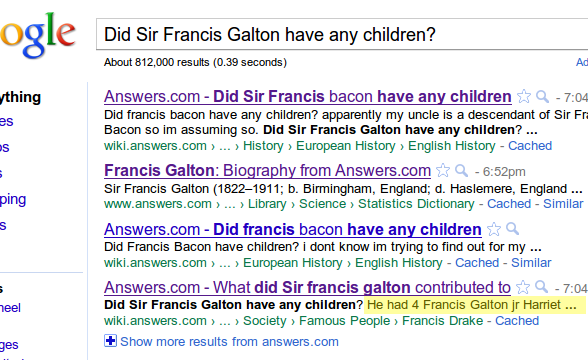
Answers.com is not a terribly good source, but it is something to at least see if you can scrounge up some extra information on. So suppose you dig a little deeper and discover that Francis Galton only married once and that this marriage was barren. So unless some historian’s account of Galton suffering from venereal disease (Kevles 12) indicates that he knocked up some ladies in Syria and managed to pop out four offspring, who happened to conveniently be named “Francis, Harriet, Matilda and Mark,” Answers.com is wrong.
Read more...
…because I don’t live in a room numbered 245s anymore. Yep. :-)

This is a cow. They munch grass next to the River Cam.
Pop quiz. What do matrix-chain multiplication, longest common subsequence, construction of optimal binary search trees, bitonic euclidean traveling-salesman, edit distance and the Viterbi algorithm have in common?
Unattributed to protect the innocent. (But you can probably guess.)
“And so these poor programmers, they had to drink this much whiskey to get the job done.” [triumphantly produces a bottle of whiskey and places it on the table.] “And this group of programmers did X, and how hard was that? Two bottles of whiskey.” [places two more bottles of whiskey on the table] “But that wasn’t fast enough. And so this group of programmers did Y. Four bottles of whiskey.” [four more bottles appear] “As you can see, this is requiring an exponentially increasing amount of whiskey.”
Read more...