I acquired a Google Nexus 7 (Wi-Fi only) over winter break. I don’t really like getting new devices: they invariably require a lot of work to setup to my liking. Here are some notes:
- Jailbreaking the device from Linux is still fiddly. Ultimately, it’s probably easiest to just find a Windows box and use the Nexus Root Toolkit. The tool is somewhat racy; try the detection code again if it fails the first time.
- Transferring files to/from Linux is a pain in the ass. I have SCP over SSHDroid working; I also tried both DropBear SSH Servers but they did not come with scp binaries and were thus fairly useless for the purpose of file transfer. SSHDroid didn’t work out of the box: I needed to apply comment 14 to make the real scp binaries get picked up in the path. By default, these apps are configured to accept password-authentication (not even keyboard-interactive!) with extremely weak default passwords: make sure you disable that. Still looking for a good rsync implementation. On the USB side, Ubuntu/Gnome/Nautilus natively recognised Nexus in PTP mode but when I tried copying files it hung. MTP is fairly unsupported by Ubuntu 12.10, but go-mtpfs works decently well given a sufficiently modern libmtp. Adam Glasgall has packaged libmtp for Quantal, so go add his PPA, and then follow the installation instructions of go-mtpfs. Update: Transferring files directly to removable media has also worked reasonably well.
- The tablet really does feel like a phone, courtesy of both being on the Android platform. But no 3G means offline is a lot more important, and the larger screen makes certain types of applications a lot more pleasant to use (Update: I’ve settled on MX Player as my video player of choice, since it supports Advanced SubStation Alpha subtitling and MKV files. Unfortunately, it doesn’t support deep color (e.g. 10-bit).)
- Micro USB to USB OTG cable is really handy, esp. for hooking up keyboards or external media. I’d dare say, it’s a more essential accessory than a cover. Note that the micro-USB port isn’t able to power USB devices with high power requirements (e.g. spinning platter external disks), so you’ll need a powered USB hub to connect them. (One symptom of this is if you try to mount an under-powered hard drive, the directory listing will persistently come up empty. It may also may make clicking noises: probably not good for the drive.) I use USB-OTG to perform mounting.
- I tried to get my paper database on Mendeley mirrored onto my tablet, but it’s been pretty tough. I’ve been trying to use Referey, which is a Mendeley-client for Android, but it requires me to somehow propagate my Mendeley SQLite database and all of my PDFs. Dropbox seems like a good match here, except that the official Dropbox client doesn’t support keeping entire folders synced (only favorite files). If you’re like me, and you don’t know exactly what papers you are going to be reading, you have to use something different, e.g. Dropsync. (BTW, if you, like me, have the clever idea of putting the SQLite database with your PDFs, so they all get synced in one folder, don’t ever “Tidy Up”: Mendeley will happily delete your SQLite database as a “foreign object”.) Mendeley and Dropbox seem to interact poorly with each other in various ways (case-sensitivity; also, Mendeley likes to make filenames that are too long, and Dropbox will stupidly and happily accept them).
- The “open windows” button doesn’t appear to properly respect when an application is closed through its own volition (i.e. through an exit button natively supported by the aplication.) This is a bit annoying.
Oh yeah, and Happy New Year. :)
Read more...
Metro maps are a visual metaphor for complex, interdependent story lines developed by Dafna Shahaf. Dafna’s thesis involved techniques for automatically taking a corpus of news articles and extracting a coherent narratives that covered the overall space. For our final CS448b project, we took one of the narratives Dafna had generated and created a system for displaying the maps. (The demo is best viewed on a large monitor.)

We only had enough time to get the viewer aspect polished, but we think that it would not be too difficult to extend this framework for the construction of metro maps (in case you don’t have access to Dafna’s algorithm).
Read more...
On the prompting of Steven Hum, I’ve put some finishing touches on my Sup patchset and am “releasing” it to the world (more on what I mean by “release” shortly.) The overall theme of this patchset is that it integrates as much Sup metadata it can with Maildir data. In particular:
- It merges Damien Leone’s sync-back patchset with the latest Sup mainline. The sync-back patchset synchronizes flags such as “Read” or “Trashed” to the Maildir, which can then be propagated back to your IMAP server using OfflineIMAP.
- Furthermore, this patchset has the ability to synchronize arbitrary labels, with a simple set of rules of what folder a message should be moved to depending on what labels it has. For example, inbox and archived messages can be kept in separate folders, so that non-Sup clients can usefully access mail you care about. (Trust me: this is really awesome.) This is coupled with a bonus OfflineIMAP patch which implements fast remote message moving.
- It implements inotify on Maildir, so a full directory scan is no longer necessary to retrieve new messages. The bottleneck for polling is now strictly OfflineIMAP.
- It implements the ability to save sent and draft messages to Maildir, so they show up in third-party clients.
- Finally, it has a number of miscellaneous bugfixes and extra hooks which I have personally found useful.
There is at least a high probability the patchset will work for you, since I’ve been using it actively for a while. Sup will sometimes crash; if it doesn’t happen reproduceably or cause data loss, I probably won’t investigate too hard. Some of my patches are a bit sketchy (especially those labeled HACK: I’ve attempted to document all the skeevy bits in commit messages and code comments.) So, how supported is this version of Sup? Well:
Read more...
You can. Imagine a version of Haskell where every constructor was strict, e.g. every field had a ! prefix. The semantics of this language are well defined; and in fact, the fine folks at CMU have known about this for some time:
Up to this point we have frequently encountered arbitrary choices in the dynamics of various language constructs. For example, when specifying the dynamics of pairs, we must choose, rather arbitrarily, between the lazy dynamics, in which all pairs are values regardless of the value status of their components, and the eager dynamics, in which a pair is a value only if its components are both values. We could even consider a half-eager (or, equivalently, half-lazy) dynamics, in which a pair is a value only if, say, the first component is a value, but without regard to the second.
Read more...
Joe Zimmerman recently shared with me a cool new way of thinking about various encryption schemes called functional encryption. It’s expounded upon in more depth in a very accessible recent paper by Dan Boneh et al.. I’ve reproduced the first paragraph of the abstract below:
We initiate the formal study of functional encryption by giving precise definitions of the concept and its security. Roughly speaking, functional encryption supports restricted secret keys that enable a key holder to learn a specific function of encrypted data, but learn nothing else about the data. For example, given an encrypted program the secret key may enable the key holder to learn the output of the program on a specific input without learning anything else about the program.
Read more...
Functions are awesome. What if we made a PL that only had functions?
Objects are awesome. What if we made a PL where everything was an object?
Lazy evaluation is awesome. What if we made a PL where every data type was lazy?
Extremist programming (no relation to extreme programming) is the act of taking some principle, elevating it above everything else and applying it everywhere. After the dust settles, people often look at this extremism and think, “Well, that was kind of interesting, but using X in Y was clearly inappropriate. You need to use the right tool for the job!”
Read more...
“Everything is a file.” [1] This was the design philosophy taken to its logical extreme in Plan 9. Any interface you could imagine was represented as a file. Network port, pixel buffers, kernel interfaces—all were unified under a common API: the file operations (open, read, write…) Plan 9 used this to eliminate most of its system calls: it had only thirty-nine, in contrast to modern Linux’s sprawling three hundred and twenty-six.
Read more...
I’m taking a Data Visualization course this fall, and one of our assignments was to create an interactive visualization. So I thought about the problem for a little bit, and realized, “Hey, wouldn’t it be nice if we had a version of hp2ps that was both interactive and accessible from your browser?” (hp2any fulfills this niche partially, but as a GTK application).
A week of hacking later: hp/D3.js, the interactive heap profile viewer for GHC heaps. Upload your hp files, share them with friends! Our hope is that the next time you need to share a heap profile with someone, instead of running hp2ps on it and sending your colleague the ps file, you’ll just upload the hp file here and send a colleague your link. We’ve tested it on recent Firefox and Chrome, it probably will work on any sufficiently modern browser, it definitely won’t work with Internet Explorer.
Read more...
October has come, and with it, another Ubuntu release (12.10). I finally gave in and reinstalled my system as 64-bit land (so long 32-bit), mostly because graphics were broken on my upgraded system. As far as I could tell, lightdm was dying immediately after starting up, and I couldn’t tell where in my copious configuration I had messed it up. I also started encrypting my home directory.
- All fstab mount entries now show up in Nautilus. The correct fix appears to be not putting these mounts in
/media, /mnt or /home/, and then they won’t be picked up. - Fonts continue to be an exquisite pain in rxvt-unicode. I had to switch from
URxvt.letterSpace: -1 to URxvt.letterSpace: -2 to keep things working, and the fonts still look inexplicably different. (I haven’t figured out why, but the new world order isn’t a complete eyesore so I’ve given up for now.) There’s also a patch which fixes this problem (hat tip this libxft2 bug bug) but I found that at least for DejaVu the letterSpace hack was equivalent. - When you manually suspend your laptop and close the lid too rapidly, Ubuntu also registers the close laptop event, so when you resume, it will re-suspend! Fortunately, this is pretty harmless; if you press the power-button again, it will resume properly. You can also work around this by turning off resume on close lid in your power settings.
- On resume, the network manager applet no longer accurately reflects what network you are connected to (it thinks you’re connected, but doesn’t know to what, or what signal strength it is). It’s mostly harmless but kind of annoying; if anyone’s figured this one out please let me know!
- Hibernate continues not to work, though I haven’t tried too hard to get it working.
- Firefox was being really slow, so I reset it. And then it was fast again. Holy smoke! Worth a try if you’ve found Firefox to be really slow.
- GHC is now 7.4.2, so you’ll need to rebuild. “When do we get our 7.6 shinies!”
My labmates continue to tease me for not switching to Arch. We’ll see…
Read more...
I was wandering through the Gates building when the latest issue of the ACM XRDS, a student written magazine, caught my eye.
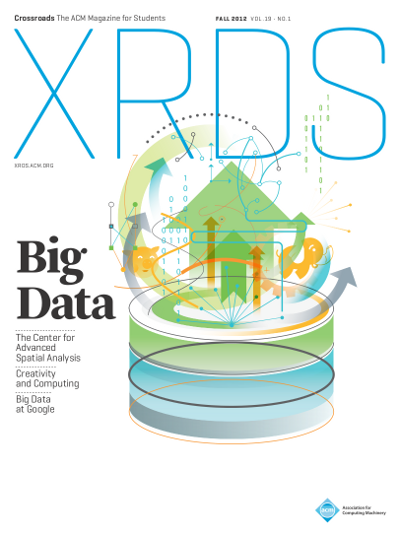
“Oh, didn’t I write an article for this issue?” Yes, I had!
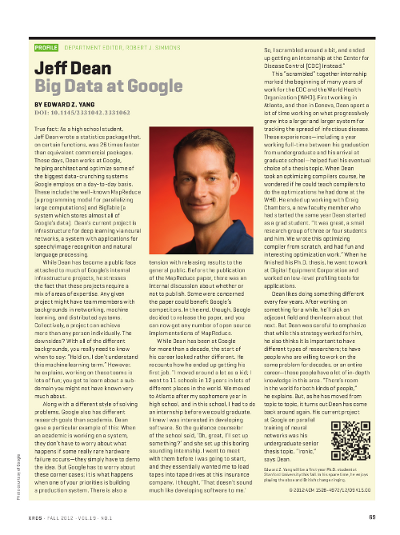
The online version is here, though I hear it’s behind a paywall, so I’ve copypasted a draft version of the article below. Fun fact: The first version of this article had a Jeff Dean fact, but we got rid of it because we weren’t sure if everyone knew what Jeff Dean facts were…
Read more...