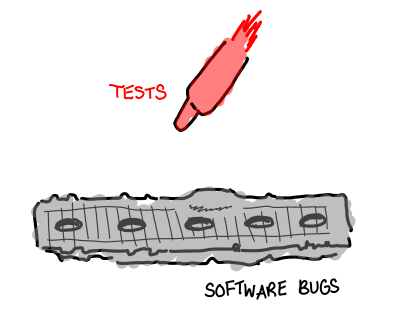
Do you remember your first computer program? When you had finished writing it, what was the first thing you did? You did the simplest possible test: you ran it.
As programs increase in size, so do the amount of possible tests. It’s worth considering which tests we actually end up running: imagine the children’s game Battleship, where the ocean is the space of all possible program executions, the battleships are the bugs that you are looking for, and each individual missile you fire is a test you run (white if the test passes, red if the test fails.) You don’t have infinite missiles, so you have to decide where you are going to send them.
Read more...
An “easy”, two-step process:
- Apply this patch for i686. (Why they haven’t fixed this in the trunk, I have no idea.)
- Configure with
CFLAGS="-U_FORTIFY_SOURCE -fno-stack-protector -O2" (this disables fortify source and stack protection which Ubuntu enables by default but interferes with glibc. You need to keep optimizations on, because glibc won’t build without it.) You’ll need to do the usual extra dance of creating a separate build directory and specifying a prefix.
Hope this helps someone else. In case you were wondering why I was building glibc, it’s because I was reporting these two bugs in iconv:
Read more...
Someone recently asked on haskell-beginners how to access an lazy (and potentially infinite) data structure in C. I failed to find some example code on how to do this, so I wrote some myself. May this help you in your C calling Haskell endeavours!
The main file Main.hs:
{-# LANGUAGE ForeignFunctionInterface #-}

import Foreign.C.Types
import Foreign.StablePtr
import Control.Monad

lazy :: [CInt]
lazy = [1..]

main = do
    pLazy <- newStablePtr lazy
    test pLazy -- we let C deallocate the stable pointer with cfree

chead = liftM head . deRefStablePtr
ctail = newStablePtr . tail <=< deRefStablePtr
cfree = freeStablePtr

foreign import ccall test :: StablePtr [CInt] -> IO ()
foreign export ccall chead :: StablePtr [CInt] -> IO CInt
foreign export ccall ctail :: StablePtr [CInt] -> IO (StablePtr [CInt])
foreign export ccall cfree :: StablePtr a -> IO ()
The C file export.c:
Read more...
Things I should be working on: graduate school personal statements.
What I actually spent the last five hours working on: transparent xmobar.

It uses the horrible “grab Pixmap from root X window” hack. You can grab the patch here but I haven’t put in enough effort to actually make this a configurable option; if you just compile that branch, you’ll get an xmobar that is at 100/255 transparency, tinted black. (The algorithm needs a bit of work to generalize over different tints properly; suggestions solicted!) Maybe someone else will cook up a more polished patch. (Someone should also drum up a more complete set of XRender bindings!)
Read more...
I upgraded from Ubuntu Natty Narwhal to Oneiric Ocelot (11.10) today. Lots of things broke. In order:
- “Could not calculate the upgrade.” No indication of what the error might be; in my case, the error ended up being old orphan OpenAFS kernel modules (for whom no kernel modules existed). I also took the opportunity to clean up my PPAs.
- “Reading changelogs.”
apt-listchanges isn’t particularly useful, and I don’t know why I installed it. But it’s really painful when it’s taking more time to read changelogs than to install your software. Geoffrey suggested gdb -p `pgrep apt-listchanges and then forcing it to call exit(0)`, which worked like a charm. Had to do this several times; thought it was infinitely looping. - Icons didn’t work, menus ugly. Go to “System Settings > Appearance” and go set a new theme; in all likelihood your old theme went away. This AskUbuntu question gave a clue.
- Network Manager stopped working. For some inscrutable reason the default NetworkManager config file
/etc/NetworkManager/NetworkManager.conf has managed=false for ifupdown. Flip back to true. - New window manager, new defaults to dunk you in Unity at least once. Just make sure you pick the right window manager from the little gear icon.
gnome-power-manager went away. If you fix icons a not-so-useful icon will show up anyway when you load gnome-settings-daemon.- “Waiting for network configuration.” There were lots of suggestions here. My
/var/run and /var/lock were borked so I did these instructions, I also hear that you should punt wlan0 from /etc/network/interfaces and remove it from /etc/udev/rules.d70-persistent-net.rules. I also commented out the sleeps in /init/failsafe.conf for good measure. - Default GHC is 7.0.3! Blow away your
.cabal (but hold onto .cabal/config) and go reinstall Haskell Platform. Don’t forget to make sure you install profiling libraries, and grab xmonad and xmonad-contrib. Note that previous haskell-platform installs will be rather broken, on account of missing GHC 6 binaries (you can reinstall them, but it looks like they get replaced.) - ACPI stopped knowing about X, so if you have scripts for handling rotation, source
/usr/share/acpi-support/power-funcs and run getXuser and getXconsole - DBUS didn’t start. This is due to leftover pid and socket files, see this bug
- Was mysteriously fscking my root drive on every boot. Check your
pass param in /etc/fstab; should be 0. - Redshift mysteriously was being reset by xrandr calls; worked around by calling it oneshot immediately after running xrandr.
- Not sure if this was related to the upgrade, but fixed an annoyance where suspend-checking (in case you are coming out of hibernate) was taking a really long time in boot. Set
resume to right swap in /etc/initramfs-tools/conf.d/resume and update-initramfs -u with great prejudice).
Unresolved annoyances: X11 autolaunching in DBUS, the power icon doesn’t always properly show AC information and is too small in stalonetray, xmobar doesn’t support percentage battery and AC coloring simultaneously (I have a patch), a totem built from scratch segfaults.
Read more...
tl;dr — Save this page for future reference.
Have you ever been in the situation where you need to quickly understand what a piece of code in some unfamiliar language does? If the language looks a lot like what you’re comfortable with, you can usually guess what large amounts of the code does; even if you may not be completely familiar how all the language features work.
For Haskell, this is a little more difficult, since Haskell syntax looks very different from traditional languages. But there’s no really deep difference here; you just have to squint at it just right. Here is a fast, mostly incorrect, and hopefully useful guide for interpreting Haskell code like a Pythonista. By the end, you should be able to interpret this fragment of Haskell (some code elided with ...):
Read more...
In his classic essay Reflections on Trusting Trust, Ken Thompson describes a self-replicating compiler bug which is undetectable by source code inspection. The self-replication is made possible by the fact that most compilers are self-compiling: old versions of a compiler are used to compile new ones, and if the old version is malicious, it can slip the same bug when it detects it is compiling itself.
A new trend is precisely this self-hosting process, but for self-certifying typecheckers: typecheckers which are used to prove their own correctness. (Note that these are powerful typecheckers, close to being able to check arbitrary theorems about code.) This may seem a little odd, since I could write a trivial typechecker which always claimed it was correct. In order to work around this, we must bootstrap the correctness proof by proving the typechecker correct in another language (in the case of F*, this language is Coq). Once this has been done, we can then use this verified typechecker to check a specification of itself. This process is illustrated below.
Read more...
What do automatic memory management, static types and purity have in common? They are methods which take advantage of the fact that we can make programs obviously correct (for some partial definition of correctness) upon visual inspection. Code using automatic memory management is obviously correct for a class of memory bugs. Code using static types is obviously correct for a class of type bugs. Code using purity (no mutable references or side effects) is obviously correct for a class of concurrency bugs. When I take advantage of any of these techniques, I don’t have to prove my code has no bugs: it just is, automatically!
Read more...
Being back in town over MIT’s Infinite Activities Period is making me think about what kind of short lecture I want to try teaching. I’ve been turning over the idea of a polyglot programming class in my head: the idea is that while most people feel really comfortable with only one or two programming languages, you can learn how to make this knowledge work for you in almost any programming language you could possible language.
Read more...
