In the beginning, there was a binary tree:
struct ctree { // c for children
  int val;
  struct ctree *left;
  struct ctree *right;
}
The flow of pointers ran naturally from the root of the tree to the leaves, and it was easy as blueberry pie to walk to the children of a node.
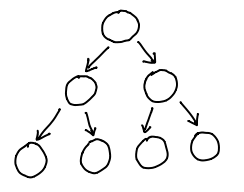
Unfortunately, given a node, there was no good way to find out its parent! If you only needed efficient parent access, though, you could just use a single pointer in the other direction:
Read more...
zip: List<A>, List<B> -> List<(A, B)>
zip(Nil, Nil) = Nil
zip(_, Nil) = Nil
zip(Nil, _) = Nil
zip(Cons(a, as), Cons(b, bs)) = Cons((a, b), zip(as, bs))

fst: (A, B) -> A
fst((a, _)) = a

last: List<A> -> A
last(Cons(a, Nil)) = a
last(Cons(a, as)) = last(as)

foldl: (B, A -> B), B, List<A> -> B
foldl(_, z, Nil) = z
foldl(f, z, Cons(x, xs)) = foldl(f, f(z, x), xs)
Good grief Edward, what do you have there? It’s almost as if it were some bastardized hybrid of Haskell, Java and ML.
Read more...
I’m happy to report that I’ll be interning at Galois over the summer. I’m not quite sure how the name of the company passed into my consciousness, but at some point in January I decided it would be really cool to work at an all-Haskell shop, and began pestering Don Stewart (and Galois’s HR) for the next two months.
I’ll be working on some project within Cryptol; there were a few specific project ideas tossed around though it’s not clear if they’ll have already finished one of my projects by the time the summer rolls around. I’m also really looking forward to working in an environment with a much higher emphasis towards research, since I need to figure out if I’m going to start gunning for a PhD program at the end of my undergraduate program.
Read more...